



SCORE2 Report 24: Nonlinear Relationship of Retinal Thickness and Visual Acuity in Central Retinal and Hemiretinal Vein Occlusion - PubMed
Source : https://pubmed.ncbi.nlm.nih.gov/37220815/
The .gov means it's official. Federal government websites often end in .gov or .mil. Before sharing sensitive information, make sure you're on a federal government site. The site is secure....
Conclusions: Two-segment piecewise linear models fit post-baseline visit data significantly better than linear models with a single slope parameter, suggesting the CST-VALS relationship in CRVO or HRVO eyes treated with anti-VEGF is not simply linear. The usually modest correlations between OCT-measured central retinal thickness and visual...

Macular vascular features of different types of diabetic macular edema using ocular coherence tomography angiography- a comparative study - International Journal of Retina and Vitreous
Source : https://journalretinavitreous.biomedcentral.com/articles/10.1186/s40942-023-00469-6
Background To compare the microvascular features of different subtypes of diabetic macular edema (DME) by optical coherence tomography angiography (OCTA). Methods A cross-sectional study including treatment-naive patients with DME. Eyes...
Conclusion: The morphology of DME, irrespective of SRF, was most significantly correlated with BCVA in treatment-naive patients and CME subtype could be an independent predictor of poor BCVA in patients with DME.

Oxidative Stress, Inflammatory, Angiogenic, and Apoptotic molecules in Proliferative Diabetic Retinopathy and Diabetic Macular Edema Patients - PubMed
Source : https://pubmed.ncbi.nlm.nih.gov/37175931/
The aim of this study is to evaluate molecules involved in oxidative stress (OS), inflammation, angiogenesis, and apoptosis, and discern which of these are more likely to be implicated in...
Conclusions/Relevance: Exploring the relationship of the abovementioned potential biomarkers between PLS and VIT may help detecting early molecular changes in PDR/DME, which can be used to identify patients at high risk of progression, as well as to monitor therapeutic outcomes in the diabetic retina.
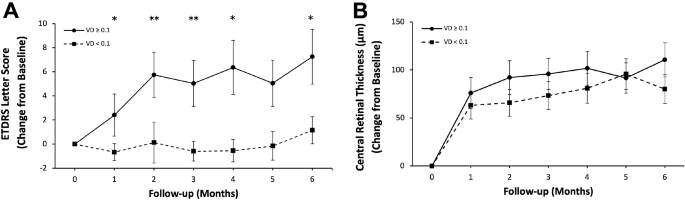
Angiographic biomarkers are significant predictors of treatment response to intravitreal aflibercept in diabetic macular edema - Scientific Reports
Source : https://www.nature.com/articles/s41598-023-35286-2
This prospective single-center study aims to identify biomarkers that predict improvement in best-corrected visual acuity (BCVA) and central retinal thickness (CRT) at 6 months, in 76 eyes with diabetic macular...
Conclusions/Relevance: Retinal angiographic biomarkers derived from OCTA and ultrawide-field FA may help predict functional and anatomic response to anti-vascular endothelial growth factor (VEGF) therapy in patients with DME. Elevated LDL is associated with treatment response in DME. These results may be used to better-select patients who...

Subretinal Pseudocysts: A Comprehensive Analysis of this Novel OCT Finding - PubMed
Source : https://pubmed.ncbi.nlm.nih.gov/37198519/
Subretinal pseudocysts are precarious OCT findings, usually disclosed in a context of subretinal fluid, and are probably transient alterations within the photoreceptor outer segments and retinal pigment epithelium (RPE) layer....
Conclusion: Subretinal pseudocysts are precarious OCT findings, usually disclosed in a context of subretinal fluid, and are probably transient alterations within the photoreceptor outer segments and retinal pigment epithelium (RPE) layer. Despite their nature, subretinal pseudocysts have been associated with photoreceptor loss and incomplete...