

Retina Health Connect
  • Saved
Anti-Vascular Endothelial Growth Factor Treatment Patterns and Outcomes in Retinal Vein Occlusion in Routine Clinical Practice | Ophthalmic Surgery, Lasers and Imaging Retina

Anti-Vascular Endothelial Growth Factor Treatment Patterns and Outcomes in Retinal Vein Occlusion in Routine Clinical Practice | Ophthalmic Surgery, Lasers and Imaging Retina

Source : https://journals.healio.com/doi/10.3928/23258160-20221026-02

To characterize treatment patterns for retinal vein occlusion (RVO)-related macular edema (ME) in routine clinical practice and its impact on long-term best-corrected visual acuity (BCVA) and central subfield thickness (CST)....


Conclusions: There exists a significant heterogeneity in anti-VEGF treatment frequency for RVO-associated ME in routine clinical practice.

  • Saved

Dr. Michael Klufas

The first biosimilar for wet (neovascular) AMD

Wet age-related macular degeneration (wAMD) is a leading cause of treatable vision loss in elderly patients. Wet AMD vision loss is characterized by the overexpression of vascular endothelial growth factor (VEGF), which triggers choroidal neovascularization and the leakage of blood/fluid into the macula. Anti-VEGF treatments have led to remarkable vision gains in many patients with wAMD.

Ranibizumab, a humanized monoclonal antibody fragment was the first FDA approved anti-VEGF agent to demonstrate improvement in visual acuity in those with wet AMD. Previously, patients were treated with lasers including PDT which led to stabilization of vision but not vision gains in the majority of patients. Intravitreal anti-VEGF is now, without question, the standard of care for wAMD in the USA and worldwide.

The first ranibizumab biosimilar was recently FDA-approved for wAMD based on an extensive review of evidence, which included structural/functional characterization and clinical/safety analyses. In the global, randomized, double-masked, parallel phase 3 equivalence study of 705 patients with AMD with subfoveal CNV, patients treated with ranibizumab-renu monthly were compared to monthly reference ranibizumab. The overall data suggest that the biosimilar and reference ranibizumab have comparable efficacy, safety, and immunogenicity, and the similarity of all primary and secondary efficacy endpoints was maintained at all timepoints up to week 52. According to the manufacturer, the price of the biosimilar is 40% lower than the reference biologic and has the potential to expand access to patients.

What are your thoughts on using the FDA-approved ranibizumab biosimilar in your practice?

  • 3yr
    Rates of enophthalmitis?
  • 3yr
    Byooviz offers comparable efficacy and safety as Lucentis, with a significantly lower cost. I think that this is unfortunate, that the only benefit of of biosimilars, in general, is lower Show More

Show More Comments

  • Saved
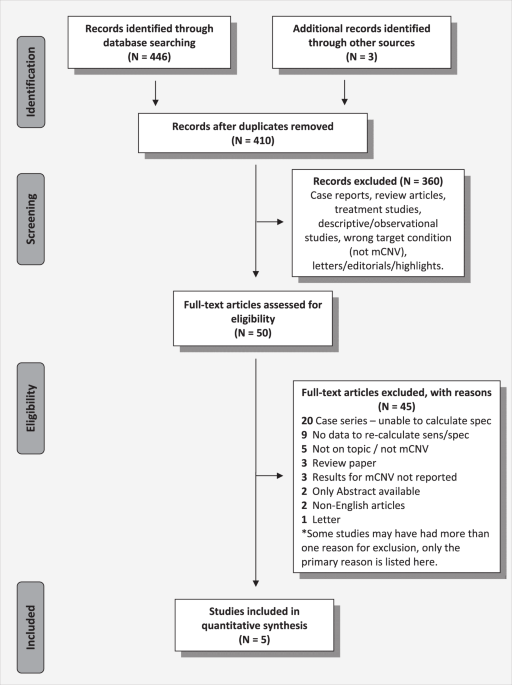
Diagnostic accuracy of OCTA and OCT for myopic choroidal neovascularisation: a systematic review and meta-analysis - Eye

Diagnostic accuracy of OCTA and OCT for myopic choroidal neovascularisation: a systematic review and meta-analysis - Eye

Source : https://www.nature.com/articles/s41433-022-02227-8

Learning Objectives Upon completion of this activity, participants will be able to: 1. Describe test accuracy, pooled sensitivity and pooled specificity of optical coherence tomography angiography (OCTA) and spectral domain...


Conclusions: OCTA can reliably diagnose mCNV in clinically suspected patients, however, SD-OCT may not reliably establish a positive diagnosis of mCNV. Future large, prospective studies with improvements in conduct and reporting are needed to strengthen these clinical recommendations.

  • 3yr
    Key Points • Source: Eye • Relevance: “The purpose of this project was to systematically review and meta-analyse studies assessing the diagnostic accuracy of optical coherence tomography angiography (OCTA) and optical coherence tomography (OCT) Show More
  • Saved
Comparison of intravitreal ranibizumab, aflibercept and bevacizumab therapies in diabetic macular edema with serous retinal detachment - PubMed

Comparison of intravitreal ranibizumab, aflibercept and bevacizumab therapies in diabetic macular edema with serous retinal detachment - PubMed

Source : https://pubmed.ncbi.nlm.nih.gov/36482707/

In patients with DME accompanied by SRD, IVA is a more advantageous option in terms of reduction in CRT and SRD height from baseline to 3 months. In the 6-month...


Conclusions: In patients with DME accompanied by SRD, IVA is a more advantageous option in terms of reduction in CRT and SRD height from baseline to 3 months. In the 6-month period of treatment, IVR, IVA and IVB therapies areanatomically and functionally similar and significant effective modalities.


  • Saved
Subfoveal choroidal thickness following pars plana vitrectomy in tractional diabetic macular edema - PubMed

Subfoveal choroidal thickness following pars plana vitrectomy in tractional diabetic macular edema - PubMed

Source : https://pubmed.ncbi.nlm.nih.gov/36476066/

After PPV for the treatment of tractional DME, a statistically significant decrease in the CMT values is detectable from the first month after surgery, followed by the improvement of BCVA...


Conclusions: "After PPV for the treatment of tractional DME, a statistically significant decrease in the CMT values is detectable from the first month after surgery, followed by the improvement of BCVA from the third month. It is worth mentioning that a decrease was found in the SCT six months postoperatively."