


Brolucizumab in Neovascular Age-Related Macular Degeneration and Diabetic Macular Edema: Ophthalmology and Diabetology Treatment Aspects - Ophthalmology and Therapy
Source : https://link.springer.com/article/10.1007/s40123-023-00647-7
Anti-vascular endothelial growth factor (anti-VEGF) therapies have become the standard of care in the treatment of neovascular age-related macular degeneration (nAMD) and diabetic macular edema (DME), resulting in a remarkable...
Conclusions: Brolucizumab offers physicians an anti-VEGF option with an extended duration of action and an improved drying effect on retinal fluid (compared with aflibercept) that could reduce the treatment burden of patients and treatment costs for the health system.
Intraocular neutralizing antibodies against aflibercept in patients with age related macular degeneration - BMC Ophthalmology
Source : https://bmcophthalmol.biomedcentral.com/articles/10.1186/s12886-022-02761-9
Purpose To detect immunoglobulins in aqueous humour of AMD patients after repeated administration of intravitreal aflibercept. Patients and methods Twenty-one patients (age: 77.85 ± 9.21 years) previously treated with intravitreal aflibercept due to...
Conclusions: According to our results, penetration of non-specific systemic antibodies through the impaired blood-retinal barrier is higher in patients with neovascular AMD than in subjects with an intact structural barrier. Evaluation of neutralizing antibodies to anti-VEGF agents in the aqueous humour can lead us to understanding tachyphylaxis...
A vision transformer architecture for the automated segmentation of retinal lesions in spectral domain optical coherence tomography images - Scientific Reports
Source : https://www.nature.com/articles/s41598-023-27616-1
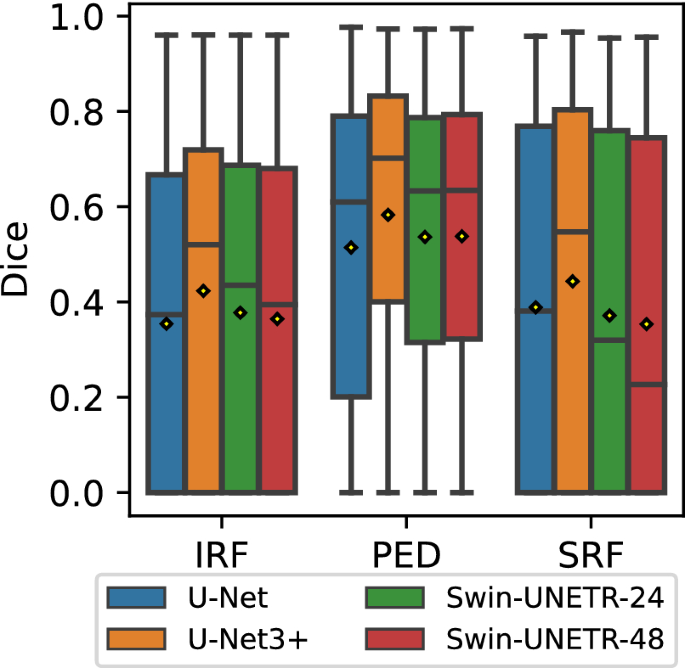
Neovascular age-related macular degeneration (nAMD) is one of the major causes of irreversible blindness and is characterized by accumulations of different lesions inside the retina. AMD biomarkers enable experts to...
Conclusions: In the clinical context of retinal lesion segmentation of OCT images, this work is a valuable contribution for improving current DL-based segmentation algorithms. Possible applications include the support of practitioners with segmentation suggestions made by the algorithm and the use of the segmentation results as a source of input...
Physicochemical and Biological Stability Assessment of SB11 (Ranibizumab Biosimilar) Under Ambient and In-Use Storage for Intravitreal Administration - Ophthalmology and Therapy
Source : https://link.springer.com/article/10.1007/s40123-022-00645-1
Introduction SB11 (Byooviz™) is a ranibizumab biosimilar that acts as a vascular endothelial growth factor (VEGF)-A inhibitor. Stability data for unopened SB11 vials at room temperature are limited and no...
Conclusions: SB11 was stable for longer periods and at higher temperatures than what is stated in the labels of the reference product (Lucentis) and SB11. The physicochemical properties, biological activity, and sub-visible particulates of SB11 in both tested settings (unopened vials at room temperature and in-use product withdrawn into...

Healing rate of macular edema secondary to branch retinal vein occlusion in two years after initiation of intravitreal ranibizumab later combined with other treatment as needed and characteristics of refractory cases - PubMed
Source : https://pubmed.ncbi.nlm.nih.gov/36595494/
In patients with BRVO-ME treated initially with IVR and later given additional treatments as needed, the healing rate was 84.6%. In eyes that healed within 2 years, BCVA improved relative...
Conclusions: In patients with BRVO-ME treated initially with IVR and later given additional treatments as needed, the healing rate was 84.6%. In eyes that healed within 2 years, BCVA improved relative to baseline throughout 24 months and at the last visit. In refractory eyes, BCVA improved only until 12 months, and thereafter deteriorated to...