


Retina Health Connect
  • Saved
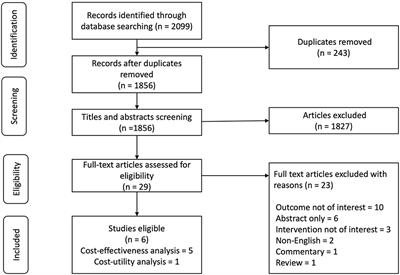
Cost-effectiveness analysis of myopia management: A systematic review

Cost-effectiveness analysis of myopia management: A systematic review

Source : https://www.frontiersin.org/articles/10.3389/fpubh.2023.1093836/full

The rising prevalence of myopia is a major global public health concern. Economic evaluation of myopia interventions is critical for maximizing the benefits of treatment and the healthcare system. This...

Conclusions/Relevance:  Treating pathologic myopia with ranibizumab and conbercept were more cost-effective than PDT. Prevention of myopia progression is more cost-effective than treating pathologic myopia.

  • Saved
Clinical Efficacy of Biosimilar Switch of Adalimumab for Management of Uveitis - PubMed

Clinical Efficacy of Biosimilar Switch of Adalimumab for Management of Uveitis - PubMed

Source : https://pubmed.ncbi.nlm.nih.gov/36803373/

The .gov means it's official. Federal government websites often end in .gov or .mil. Before sharing sensitive information, make sure you're on a federal government site. The site is secure....

Conclusion: Amgevita is safe and effective for inflammatory uveitis with non-inferiority to Humira. Significant numbers of patients requested to switch back due to side effects including injection site reactions.
 

  • Saved

Dr. Michael Klufas

Biosimilars in Ocular Indications

Biologics are naturally sourced molecules engineered to target specific pathways in many inflammatory and autoimmune disorders. In the last decade, there has been an increased interest in the development of biologics in the treatment of inflammatory diseases (typically but not always rheumatologic conditions). Anti-VEGFs, given intravitreally, are increasingly being utilized in ocular indications including age-related macular degeneration and diabetic retinopathy. These biologics have significant clinical benefits, including gain of vision, but may come at a high financial cost. Importantly, the emergence of biosimilars is expected to play a key role in lowering healthcare costs and improving patient access. As a step towards improved patient access and decreased burden to the healthcare sector, the EMA and the Heads of Medicines Agencies have issued a joint statement confirming that biosimilar medicines approved in the EU are interchangeable not only with their reference medicine, but also with an equivalent biosimilar. In 2022, the FDA has also shown a positive stance towards biosimilar approvals with recent biosimilars being approved without ‘switching’ studies.

What are your perceptions of the efficacy and safety of ocular biosimilars? What are the barriers or challenges faced by biosimilars and their uptake?

  • 3yr
    It seems the main advantage would be price. While this seems beneficial on the surface, most of the patients needing these treatments are of Medicare age and therefore would Show More
  • 3yr
    My perception is that they are safe. The challenge is how to make it more accessible and cut down cost.


Show More Comments

  • Saved
Models and Algorithms for the Refinement of Therapeutic Approaches for Retinal Diseases - PubMed

Models and Algorithms for the Refinement of Therapeutic Approaches for Retinal Diseases - PubMed

Source : https://pubmed.ncbi.nlm.nih.gov/36900119/

We are developing a Virtual Eye for in silico therapies to accelerate research and drug development. In this paper, we present a model for drug distribution in the vitreous body...

Conclusions/Relevance: We describe the first steps towards virtual exploration and improvement of therapy for retinal diseases such as age-related macular degeneration.

  • Saved
Long-Term Visual Outcomes in Neovascular Age-Related Macular Degeneration Eyes With Baseline Macular Atrophy on Anti-Vascular Endothelial Growth Factor Treatment - PubMed

Long-Term Visual Outcomes in Neovascular Age-Related Macular Degeneration Eyes With Baseline Macular Atrophy on Anti-Vascular Endothelial Growth Factor Treatment - PubMed

Source : https://pubmed.ncbi.nlm.nih.gov/36884230/

Regardless of MA status, 5- and 7-year BVA change lacked clinical relevance. If receiving regular treatment for 5+ years, patients with baseline MA achieve comparable visual outcomes to those without...

Conclusion: Regardless of MA status, 5- and 7-year BVA change lacked clinical relevance. If receiving regular treatment for 5+ years, patients with baseline MA achieve comparable visual outcomes to those without MA, with similar treatment and visit burdens.